Chinese Scientist New VP of UNESCO Women's Group
Wang Yanfen, executive vice-president of the University of Chinese Academy of Sciences, was elected vice-president of UNESCO's Organization for Women in Science for the Developing World (OWSD) for the Asia-Pacific region at the organization's 7th General Assembly in Bogota, Colombia, on Tuesday, further consolidating China's position in advancing global equality and its commitment to building the capacity of developing countries.
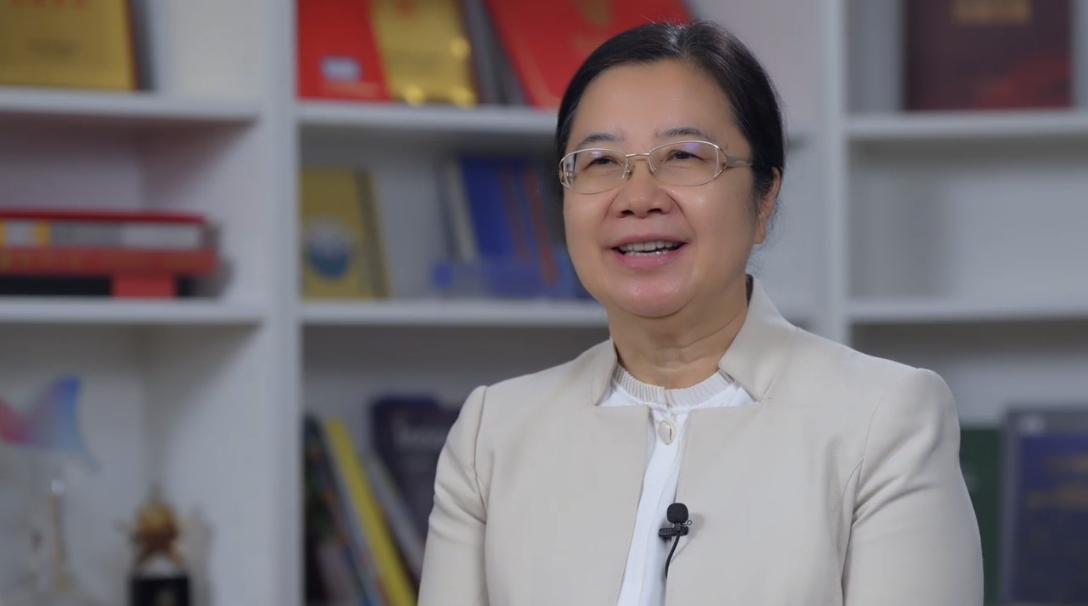
Established in 1989, the OWSD aims to strengthen the role of women scientists from the Global South in science and technology. In her election address, Wang said science knows no borders and presented an "ambitious and actionable" vision for her role as vice-president.
"I will make active efforts to help forge stronger regional linkages and collaborations between the Asia-Pacific region and the other OWSD regional networks; I will actively work to promote the OWSD's vision that women are not only brought to science but supported to grow and thrive; I will also dedicate myself to promoting women scientists' role in addressing the grand common challenges of humanity, ensuring that women scientists' voices are well and better heard on the global scientific arena," she said.
Engaged in soil ecology and geograhpy for 30 years, Wang focuses on the mechanisms of soil carbon stability under global changes. She has established a series of in-situ manipulated experiment platforms in northern China's grasslands to study ecosystem responses and adaptations to global changes and human activities. Her research highlights the benefits of moderate human intervention in dryland ecosystems, thus reconciling the conflict between utilization and conservation.
She has published five monographs and more than 350 papers in major scientific journals, including Nature Sustainability, Nature Reviews Earth & Environment, Nature Communications, National Science Review, Global Change Biology, and Journal of Ecology. These findings provide a solid foundation for policymaking related to sustainable ecosystem management.
Wang also takes an active part in international communication and cooperation as vice-president of the International Scientific Centre of Fertilizers, a committee member of the Partnership for Skills in Applied Sciences, Engineering and Technology, and an independent board member of the International Centre for Integrated Mountain Development.
In addition, she co-initiated the Global Dryland and Ecosystem Programme and chaired the Sino-German research and training program Tree Diversity Interaction.
Wang is the third Chinese scientist to hold the position, following Hu Qiheng, an academician of the Chinese Academy of Engineering and a researcher at the Chinese Academy of Sciences' Institute of Automation, and Fang Xin, an academician of the Third World Academy of Sciences and a professor at the University of Chinese Academy of Sciences.