China's Innovation Ecosystem Empowers Young Scientists
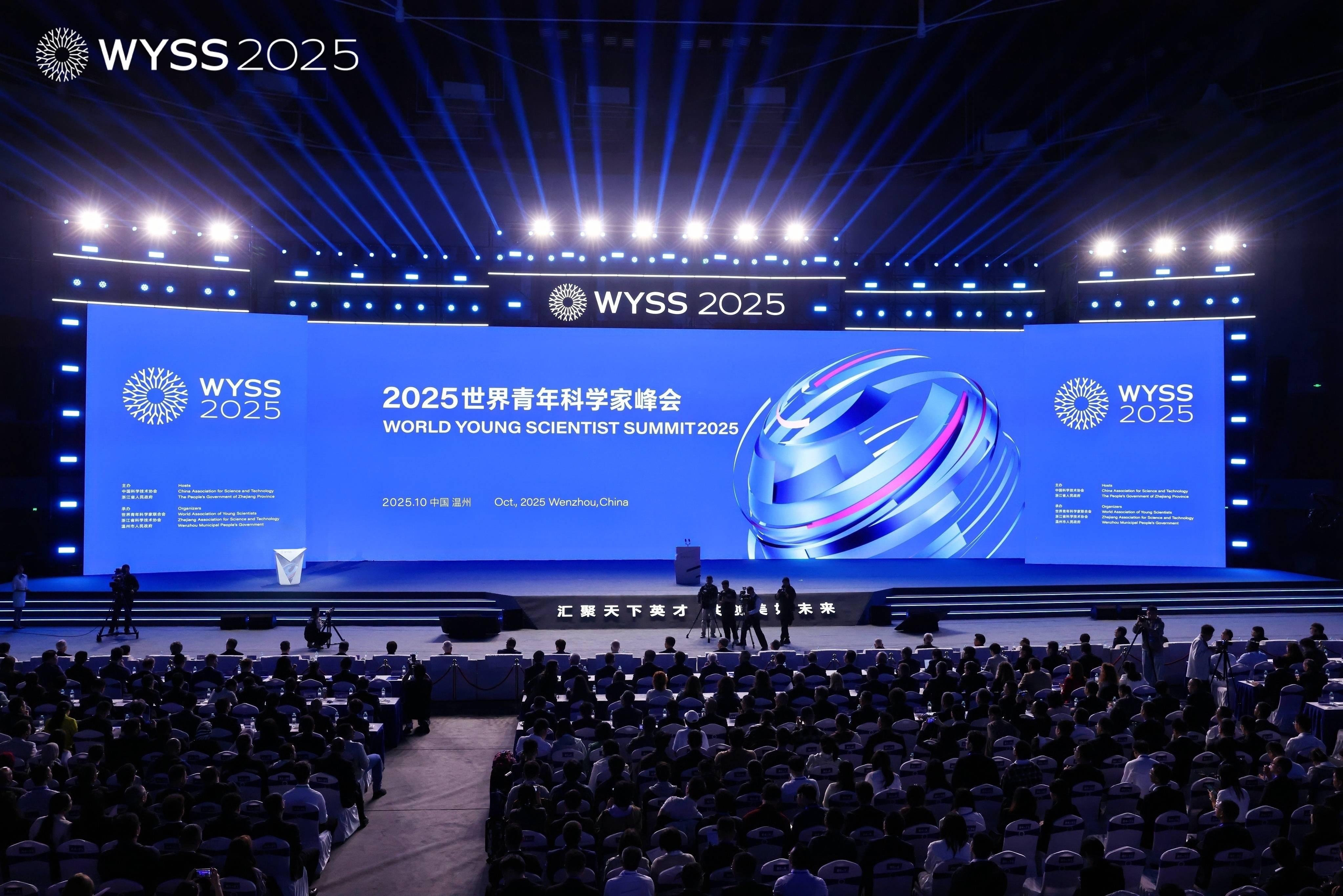
The 2025 World Young Scientist Summit (WYSS), held in Wenzhou, Zhejiang province, from October 24 to 26, has emerged as a powerful symbol of China's commitment to fostering a globally inclusive and supportive environment for scientific innovation.
As the third "Young Scientists Sustainable Development Goals Award" was announced at the event, drawing a record 204 applications from 29 countries and regions, it became clear that China is advancing its own technological frontiers and creating a dynamic ecosystem where global young scientists can innovate, collaborate and lead.
A call for collaboration
Donald Bruce Dingwell, president of Academia Europaea and a foreign academician of the Chinese Academy of Sciences, set the tone of the summit with his address.
Applauding the WYSS as a "cornerstone event in the global scientific calendar" that was evolving into "a dynamic and open ecosystem of exchange," he emphasized that today's greatest challenges, such as climate change, energy security and biodiversity loss, "recognize no national borders."
Hoping that the era of isolated scientific endeavor was over, Dingwell said, “Our future depends on our ability to work together across borders and disciplines."
He placed young scientists at the heart of this collaborative future. "You are the true catalysts of innovation," he told the audience. "You arrive with new perspectives, unburdened by too much conventional wisdom."
But he warned that this potential "cannot flourish in isolation." Therefore, he called on the established scientific community to provide young researchers not just with funding, but with leadership opportunities, mentorship, access to state-of-the-art facilities, and, above all, "the freedom to take intellectual risks."
Dingwell's message was clear: A supportive environment that tolerates well-intentioned failure is essential for breakthroughs.
The award winners embodied the power of this open, collaborative model.
Professor Mariangela Russo of the University of Turin, Italy, whose research uncovered a key "stress response mechanism" in colorectal cancer cells that leads to drug resistance, emphasized the importance of global partnerships.
"This is not my personal achievement," she said. "I am here thanks to the collaboration of many colleagues in my lab, thanks to my mentor, and thanks to numerous collaborators around the world who have challenged my perspective."
Rising center of science
The vision of China as a rising center for global science is already shaping real-world career decisions at the highest levels. Stella Christie, vice minister of Higher Education, Science and Technology of Indonesia and a cognitive scientist, left tenured academic positions in the United States to join Tsinghua University in Beijing.
"The reason is simple," she said. "The future of science is in China."
Her decision reflects a growing trend: Scientists are increasingly being drawn to China's momentum, its substantial investment in research, and its ability to implement large-scale, interdisciplinary projects.
Describing China's research ecosystem as "innovative, futuristic and implementing," Russo highlighted the environment that values not just ideas, but their execution. She urged young scientists to "be brave — be courageous enough — to question yourself, to question the way you think," a mindset nurtured by platforms like the WYSS.
Professor Wolfgang Tress of Zurich University of Applied Sciences, Switzerland, a leading researcher in photovoltaic technology, echoed this sentiment. "In China, there is tremendous growth and a strong drive for advancement," he told Science and Technology Daily. "The government and institutions provide substantial support and offer abundant resources, extensive development opportunities and a dynamic research environment."
He contrasted this with Europe, where "the situation tends to be more stable but often fragmented and less rapidly evolving." In the fields he is acquainted with, he has seen China “making remarkable progress, achieving impressive results, and cultivating a growing number of outstanding scientists."
China is building a platform where the world's brightest young minds can connect, experiment and innovate.
As Dingwell concluded, "The future of science is bright. The future of science is in your hands."
With its open doors and supportive ecosystem, China is ensuring that those hands—wherever they come from—have the freedom, resources and global network they need to shape a better future for all.