Empowering People Through Innovation, Collaboration
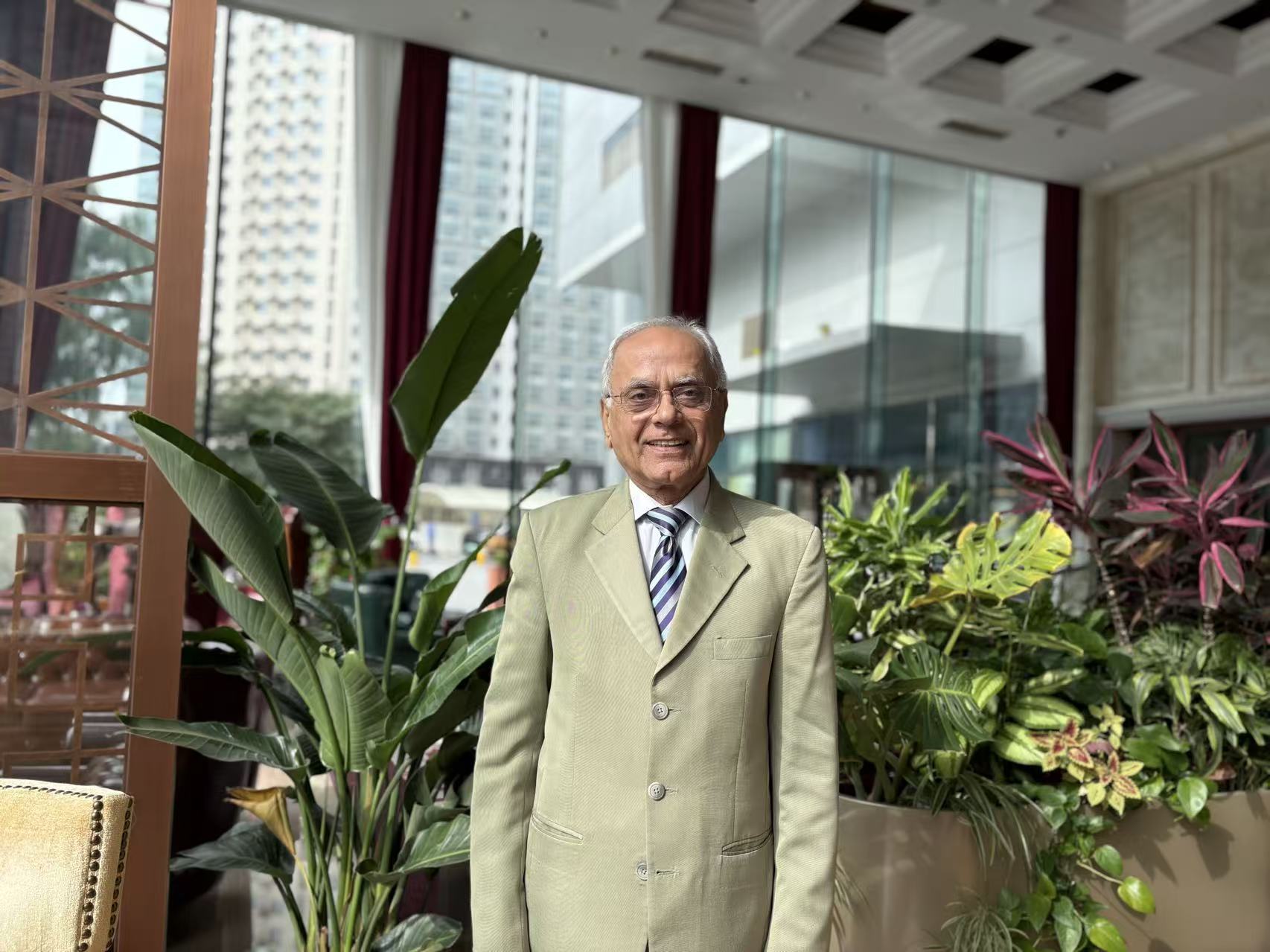
Dr. Manzoor Hussain Soomro speaks not as a theoretical academic, but as someone who has lived the journey from hardship to global influence. Born into a landless farming family in Pakistan, he rose to become founding president of the Economic Cooperation Organization Science Foundation, a senior advisor to UNESCO and the UN Food and Agriculture Organization, and a recipient of Chinese Government Friendship Award.
Even today, the expert in science education and science and technology policy still remembers the most profound moment in his life: standing in a village field, watching farmers apply scientific knowledge to grow better crops and realizing, through tears of joy, that he had helped change lives like his own.
In a recent conversation with Science and Technology Daily, Soomro reflected on his insights on youth and female development, the power of science and technology, and the growing role of collaboration in global sci-tech landscape.
Global citizenship needed
When asked about the most important quality for young researchers, Soomro emphasized dedication and consistency over innate brilliance. He believes young people are the future of global development, especially if they are critical thinkers focused on solving real-world problems. While intellectual ability is important, he argues that sustained effort and a clear sense of purpose are far more decisive in achieving meaningful research outcomes.
This belief stems from his own upbringing. His father taught him the value of hard work and perseverance. "I learned consistency from my father," Soomro recalled. "He was a landless farmer, but he was consistent. That's what I carry with me."
He says today's youth must not only excel in science, but also need to embrace global citizenship. "It's not just [about] future scientists and engineers. We also need future leaders in diplomacy, [and] all [other] fields to think positively and globally," he said, pointing to ongoing conflicts and a complicated global landscape.
For Soomro, the solution lies in collaboration, not competition. "This is what I admire about Chinese leadership. They talk about working with others, even with powerful nations like the U.S. There's so much to be done together."
He also said that if we apply this way of thinking to space exploration and tackling climate change, we can prevent making the same mistakes in space that we have made on Earth.
Empowering women in science
Last week, Soomro came to Beijing for an international seminar about "She Power" in science. Gender equity in science has always been close to Soomro's heart. "Globally, only 31 percent of researchers are women," he noted. "Yet women make up nearly 50 percent of the population. If we don't tap into this talent, we're wasting half the world's potential."
He praised China's progress in this area. "China's ratio is better than many countries," he said, hoping for more progress. He highlighted a cultural strength he observed in China and other Eastern societies: the emphasis on family and intergenerational care. Still, he emphasized the importance of visible role models. "If young girls see more women leaders in science, they'll follow. We need to create those pathways."
The engine of BRI
The Belt and Road Initiative (BRI) is often praised for its extensive infrastructure projects, including bridges and railways. But Soomro sees a deeper transformation. "Infrastructure's role needs to be maximized," he said. "We must focus on the person behind the machine."
During a lecture in Beijing on industrial transformation in BRI countries, he analyzed how development efforts have evolved from constructing roads and railways to investing in education, training, and policy frameworks that ensure sustainable growth.
He applauded China's vision about integrating human resource development with infrastructure, calling it a necessary step for long-term impact.
As vice president of the Belt and Road International Science Education Coordinating Committee, Soomro has worked to strengthen science education across partner countries. Under this initiative, he and his team developed a curriculum exploring historical exchanges along the Silk Road, including those led by Zheng He, an ancient Chinese diplomat from the Ming dynasty, and Moroccan scholar and traveler Ibn Battuta, linking cultural heritage with sci-tech and people-to-people exchanges.
He sees BRI not just as an economic project, but as a cultural and scientific bridge. "China shares technology at affordable prices. They offer quality gadgets at lower costs. This empowers developing nations."
The soul of science
In an age of AI and remote learning, Soomro champions balance. "All technology is a tool," he said. "Nuclear energy can destroy or heal. AI can educate or mislead."
He praised AI's role in education, especially for shy students who can now learn independently. "But the content matters," he warned. "I've used some AI tools, but sometimes the information is wrong. Developers and users alike must be responsible."
He welcomed UNESCO's development of global AI ethics guidelines and credited China for its leadership in advocating for a unified international framework during a UN conference. For Soomro, the true value of science and technology depends on how it is used. The goal should not be innovation for its own sake, but innovation that serves human dignity and collective well-being.
As our conversation ended, he offered one final piece of advice: "Ask your grandparents about their struggles. Remember their sacrifices. Innovation is important, but so is remembering where we came from."
In a world often driven by speed and profit, Soomro reminds us that the most powerful science is the kind that uplifts people, honors culture and dares to care.