Giant Solar Telescope Empowers Space Observation
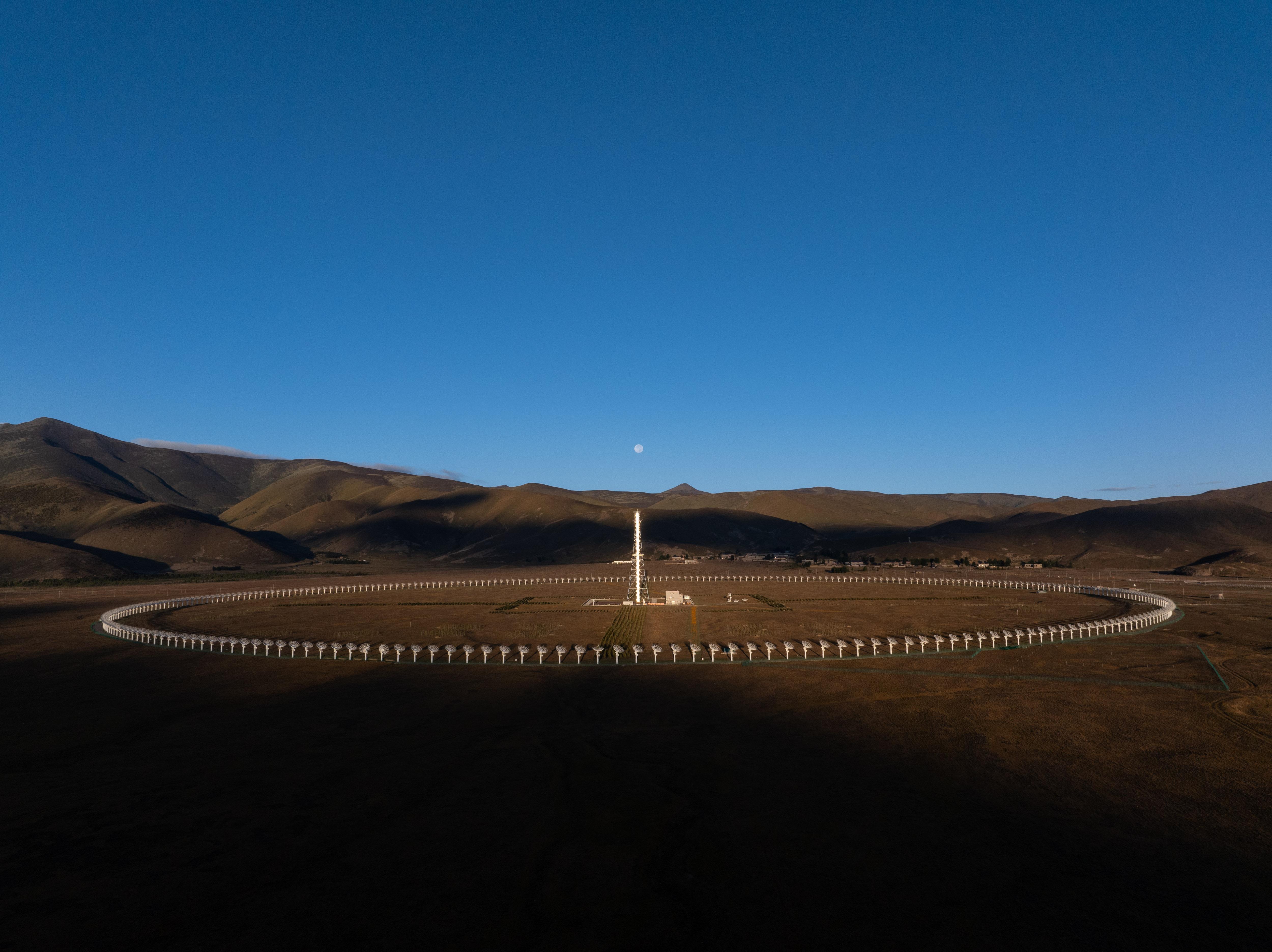
In the remote highlands of Daocheng, a county nestled 4,700 meters above sea level in Sichuan province in southwest China, a groundbreaking scientific feat promises to reshape our understanding of our closest star.
The 2.5-meter Wide-field and High-resolution Solar Telescope (WeHoST), a national major scientific instrument project recommended by China's Ministry of Education and approved by the National Natural Science Foundation, represents not only a technological marvel, but also a strategic leap for the quest to decode solar mysteries. Its supporting facilities are expected to be completed by the end of 2026.
As the world's largest axisymmetric solar telescope, WeHoST is a symbol of China's contribution to global space science and planetary safety in an increasingly complex cosmic environment.
Filling the gaps in global solar observation
Though the Sun is vital to life on Earth, our scientific instruments fall short of capturing the full complexity of its behavior. Existing solar telescopes, while able to provide minute surface features of the star, have a limited field of view. WeHoST fundamentally changes the equation. With its 2.5-meter aperture, it combines ultra-high resolution with a greatly expanded observational field, three to four times wider than that of existing instruments.
"Just like using a microscope to observe bacteria, current solar telescopes can capture fine details but lack the broad perspective needed to fully understand solar eruptions. With WeHoST, we aim to bridge that gap," explained Professor Ding Mingde, the project's chief director and a professor at Nanjing University.
Dual approach to space weather monitoring
WeHoST will not operate in isolation. It joins the "Xihe" satellite, China's first space-based solar observation platform, in a strategic configuration known as "earth-space synergy."
Academician Fang Cheng from the School of Astronomy and Space Science at Nanjing University pointed out that WeHoST will enable multi-height observations of solar atmospheric changes. The telescope could provide the most comprehensive continuous observations of solar active regions ever achieved from their formation to evolution. Combined with "Xihe", it will significantly improve China's capability in monitoring and forecasting space weather.
Some dynamic solar events, like solar flares, coronal mass ejections, unleash energy equivalent to billions of nuclear bombs. They have profound impacts on Earth's technological systems, from disrupting global communications and navigation to threatening satellite integrity and even terrestrial power grids.
In this context, WeHoST is not just a telescope; it's a planetary early-warning system, capable of advancing the predictive science of space weather.
This capability is globally significant. As we enter an age of increasing dependence on satellites, renewable energy grids, and deep-space communication systems, understanding and predicting extreme solar activity becomes a matter of international security and sustainable development.
By contributing the first observations of the full life cycle of solar eruptions, China is offering critical data to global scientific networks, enhancing the world's collective capacity to respond to space weather disasters that know no borders.
From solar to nighttime observations
WeHoST will not study the Sun alone. Thanks to an innovative optical design that enables swift redirection of light paths, the telescope can transition from solar to nighttime observations in under 10 minutes. This flexibility empowers it to contribute to one of the most exciting frontiers in astrophysics: time-domain astronomy — the study of transient cosmic events such as supernovae, gravitational wave counterparts, and black hole flares.
In a world where scientific leadership is defined not by isolated breakthroughs but by interconnected systems and global cooperation, WeHoST stands as a dual-purpose platform for both solar and stellar discoveries. Its presence represents a strategic scientific vision that seeks to unlock cosmic secrets not just for national pride, but for the shared advancement of human knowledge.
"International efforts are accelerating in this field, with new technologies being developed to push the boundaries of our understanding of the universe," Ding said. "WeHoST will leverage China's geographical advantages to support global networks for time-domain observations, enabling new discoveries and insights into the unknown."