Global experts convene to unlock the future of talent cultivation in the AI era
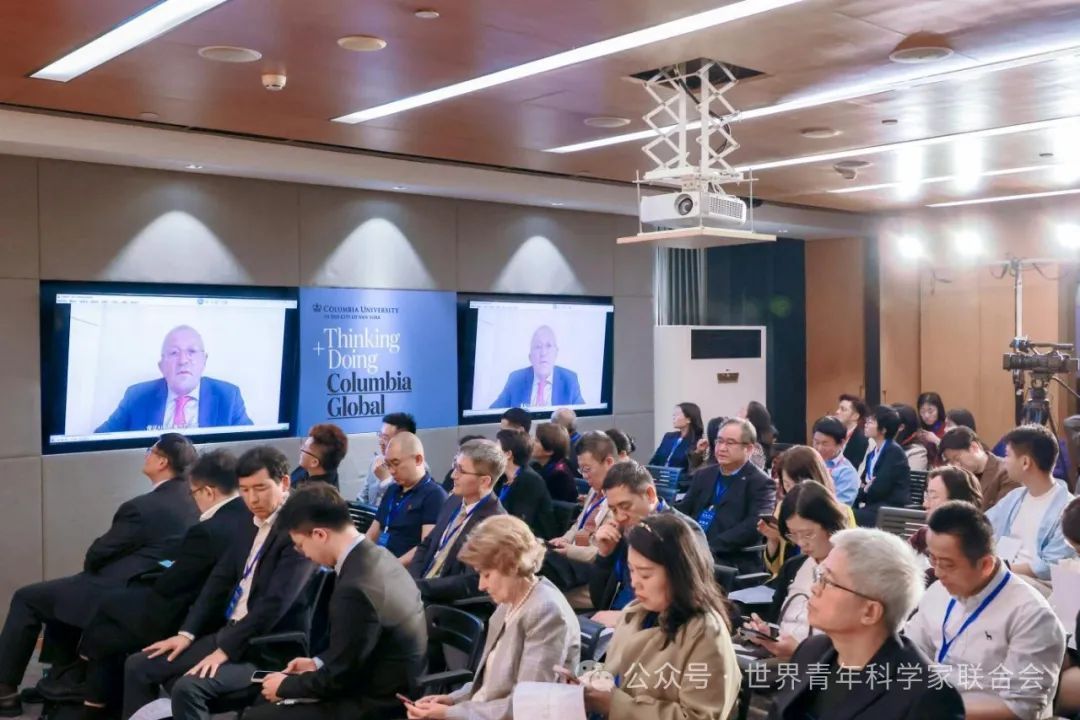
On April 18, 2025, the symposium themed "Intelligence Inspires the Future: Global Education Reform and Paradigm Revolution in Scientist Cultivation" convened in Beijing, bringing together over 80 experts from academia, education, sci-tech industries, and international organizations. Hosted by the United Nations Global Sustainable Development Goals and Leadership Development Center, and co-hosted by Columbia Global Centers Beijing, the World Association of Young Scientists, Future Media Convergence Institute, Global Youth Development Alliance, and EU-Asia Centre, the event fostered in-depth exchanges on reshaping education in the AI era and proposed cutting-edge strategies for upgrading global education ecosystems.
Keynote Speeches: Aligning Education with the Times
Centered on the topic - "Educational Restructuring and Sustainable Resource Synergy in the AI Era," the forum addressed major challenges posed by generative AI, brain-computer interfaces, and other emerging technologies.
Irina Bokova, former Director-General of UNESCO, emphasized in her keynote speech that AI presents a pivotal opportunity to reshape educational equity and quality. She advocated for a sustainability-oriented transformation in education, prioritizing critical thinking and a balanced integration of technology and humanistic values.
Turing Award laureate Joseph Sifakis, speaking via video, proposed the concept of "self-directed learning systems" , stressing AI’s role in supporting lifelong learning while highlighting the need for deeper research into human agency within AI frameworks.
Roundtable Discussions: Multidisciplinary Perspectives
A high-level panel featuring Irina Bokova and Deng Xiaotie, Foreign Member of the European Academy of Sciences, sparked lively debate. Deng Xiaotie, also the Director of the Center for Multi-Agent Research at Peking University, presented how multi-agent systems could optimize educational resource allocation. Xiong Yongchang, Principal of Beijing 101 Middle School, acknowledged AI’s supportive role while cautioning against over-reliance and emphasizing the irreplaceable role of teachers in providing humanistic guidance.
Experts reached a consensus around a three-pronged principle for STEM education in the AI era: ethics as the foundation, technology as the enabler, and human-centricity as the core. They called for erasing disciplinary silos, embedding ethical reasoning into technical training, and establishing dynamic evaluation mechanisms to align curricula with societal needs.
Industry-Academia Synergy and Education Reform
Huang Tianyin, Vice Provost and Dean of School of Clinical Medicine at Tsinghua University, pointed out traditional medical education suffers from long training cycles and outdated curricula and urged the development of agile curriculum adjustment mechanisms. CAS Professor Yi Weidong emphasized fostering students’ questioning abilities to strengthen alignment with industry needs. Gu Rentao, Executive Dean of the Future Institute at Beijing University of Posts and Telecommunications, advocated for "human-AI symbiosis" in pedagogy, in an effort to help both AI and teachers give full play to their respective strengths. Other experts proposed systemic reforms to bridge education and industry chains.
Consensus emerged on building a dynamic, interdisciplinary ecosystem that balances technological agility with educational essence, cultivating professionals equipped for future industrial transformations.
Xiao Na, Executive Director of Columbia Global Centers Beijing, positioned data literacy as a cornerstone of liberal arts education. Gao Chunbo, Secretary General of the World Association of Young Scientists, framed AI as a tool requiring independent thinking among students. Bi Siwen, Deputy Director of the State Key Laboratory of Remote Sensing Sciences at the Chinese Academy of Sciences and Academician of the International Eurasian Academy of Sciences , shared insights into how diverse knowledge systems can support the growth of future scientists. Sun Jing, Correspondent and Director of the Science Division, International Department at Xinhua News Agency, expressed concern over the mismatch between the pace of AI development and education reform, as well as the potential downsides of AI.. Professor Zhang Lin from Beihang University emphasized that future scientists should develop "T-shaped expertise"—excellent professional competence coupled with cross-disciplinary collaboration skills.
After in-depth discussions, experts have reached a clear consensus: cultivating future scientists requires the establishment of a new paradigm. The paradigm includes strengthening data-driven general education, promoting interdisciplinary projects, and leveraging international exchanges to nurture scientists capable of integrating diverse resources in complex research environments.
Actionable Initiatives
The symposium culminated in the launch of interconnected global projects by the UN Global Sustainable Development Goals and Leadership Development Center, including the "UN SDGs Behavioral Science Academic Network," designed to embed scientific methodologies into educational reform.
These initiatives aim to build a multi-tiered innovation ecosystem for cultivating next-generation scientists, thus injecting continuous vitality into global education upgrade.
Unified Vision for Collaborative Progress
In closing, Gao Ling, Director of the UN SDGs and Leadership Development Center, issued a call to action for all sectors to jointly advance education reform.. Participants unanimously agreed: educational transformation in the AI era requires collaboration among governments, schools, enterprises, and international organizations. The transformation must be rooted in ethics, driven by technology, and centered on human values—shifting from knowledge transmission to the cultivation of capabilities. The goal is to build an open, inclusive, and sustainable global education ecosystem, contributing new momentum to the realization of the UN 2030 Agenda.
The United Nations Global Sustainable Development Goals and Leadership Development Center—the first UN Institute for Training and Research (UNITAR) affiliated institute in the Asia-Pacific region dedicated to SDGs capacity-building—focuses on leadership development, climate action, technological innovation, and volunteerism. This symposium marked the launch of its 2025 academic series, reinforcing its mission to cultivate globally minded leaders for SDGs implementation worldwide.
Source: Xinhua, Voice of CAST