Intelligent Solutions Expand Automated Farms
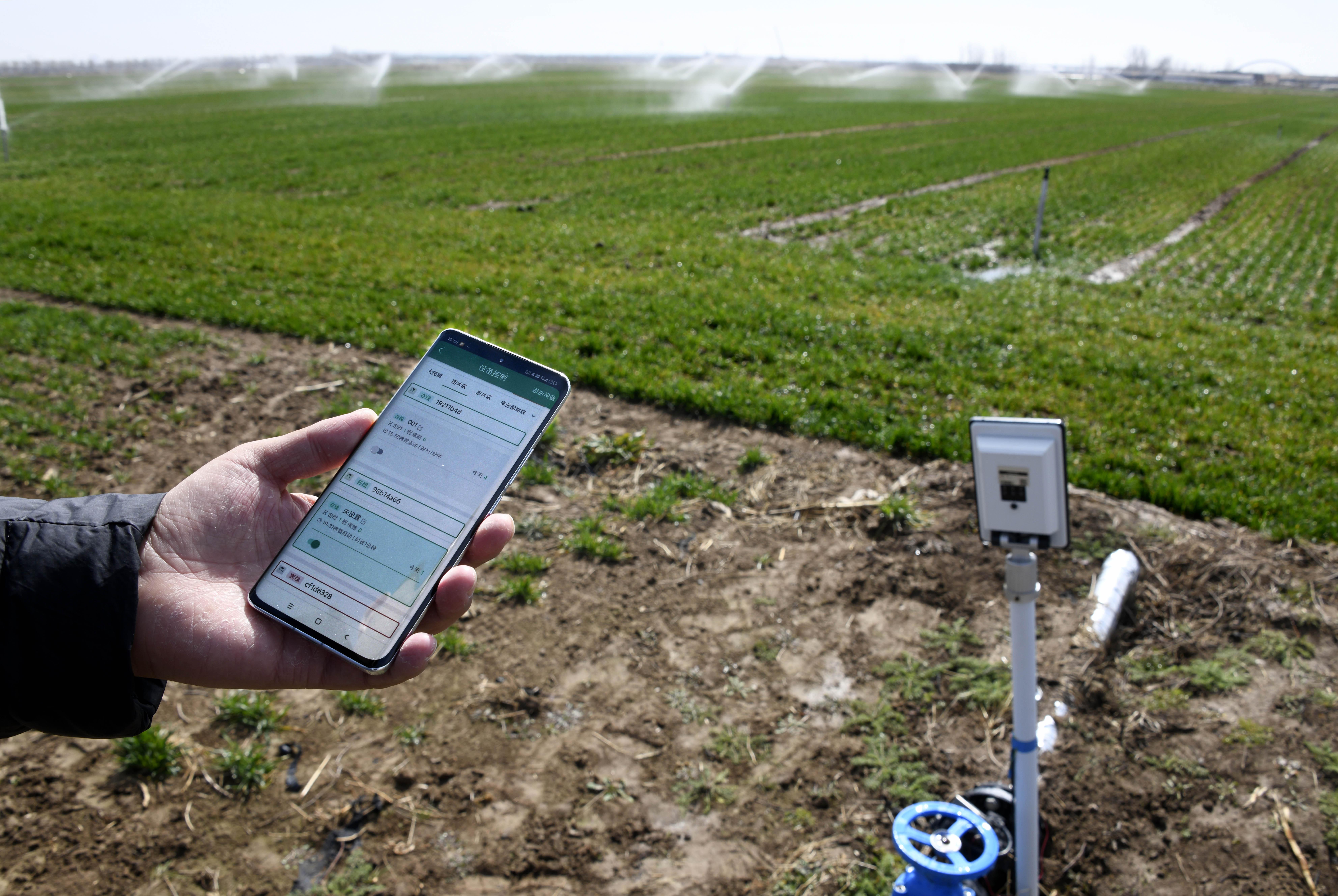
As spring planting season begins, farmers across China are working at full capacity, with technology-driven agriculture leading the way. Intelligent farming solutions are accelerating the expansion of unmanned farms, transforming traditional agriculture with automation.
Boosting efficiency through automation
In Weili county in southern Xinjiang Uygur autonomous region, a 3,000-mu unmanned farm showcases cutting-edge agricultural innovation. Developed by XAG, a smart agriculture technology company, this high-tech demonstration project integrates aerial and ground robots, agricultural Internet of Things (IoT), and an intelligent farm management system.
Unlike traditional farms, the super cotton field is dominated by smart machines that work autonomously. According to Ai Haipeng, the farm's manager, 75 percent of the farm has been automated since 2021, with last year's cotton yield reaching 529 kilograms per mu.
"The unmanned farm relies on IoT, big data, AI, 5G, and robotics to remotely control agricultural equipment, enabling fully automated farming," said Wu Huarui, a researcher at the Beijing Academy of Agriculture and Forestry Sciences. The primary goal is to reduce labor dependency, particularly in large-scale farming, where machines have taken over tasks from planting to harvesting.
Over the years, research institutions and enterprises in China has explored unmanned agricultural technologies.
In Taigu district, Jinzhong city, Shanxi province, an unmanned system was used to plant and harvest carrots, significantly increasing productivity.
Traditionally, harvesting a 200-mu carrot field required 20 to 30 workers. In contrast, an unmanned harvesting machine is nearly ten times more efficient than manual labor.
Challenges in automation
Despite rapid advancements, key challenges remain. The core technologies of unmanned farms revolve around four major processes: plowing, planting, managing, and harvesting.
For example, Wu notes that mechanization rates for transplanting and harvesting vegetables remain below 10 percent. "Current domestic automatic transplanters have a 10-20 percent seedling failure rate, requiring manual replanting," Wu said.
Additionally, the diversity of vegetables and their varying growth environments pose further obstacles. "Most existing Chinese harvesting machines can only handle a single crop." Wu said. These challenges go beyond mechanical reliability and involve systemic issues such as machine-friendly crop breeding and standardized seedling production.
According to Ai Haipeng, while the XAG project has made strides in pest control, smart irrigation, and remote sensing, 25 percent of the plowing and planting processes still require manual intervention. This is due to limitations in autonomous driving technology for agricultural machinery and the need for fully automated, lightweight seeders.
Breakthroughs in these areas demand substantial investment and long-term technological accumulation.
Reducing costs and establishing standards
After four years of operation, the XAG project has seen rising yields, becoming a benchmark in cotton farming. However, scaling up remains challenging.
Different regions have varied soil conditions, climates, and crop types, demanding high adaptability from smart agricultural machinery. Although XAG has developed several smart agricultural machines for different environments, local adaptations are still required.
To scale up unmanned farming, new promotion models must be explored. "Collaboration with local governments and agricultural cooperatives is essential to expand this technology," Ai said.
This year's government work report emphasizes the need to advance high-standard farmland construction. According to Hu Lian, vice dean of college of engineering, South China Agricultural University, high-standard farmland is a prerequisite for the large-scale application of unmanned farming, particularly for staple crops like rice.
"With unified planning and standardized farmland, unmanned farms can integrate seamlessly, improving productivity while accelerating the adoption of unmanned farm technology," Hu said. He urged authorities to increase investment in standardized farmland development and establish regulations to support the broader implementation of unmanned farming.