Tech with Heart, AI for Good | AI with a Human Touch
In 1949, pioneering computer scientist Edmund Callis Berkeley envisioned a future filled with thinking machines in his book Giant Brains, or Machines That Think. Decades later, his vision has become a reality with artificial intelligence (AI) reshaping industries, societies and daily lives.
The progress however, is far from straightforward. While AI excites people with its potential, it also raises questions about ethics, safety and its impact on human life.
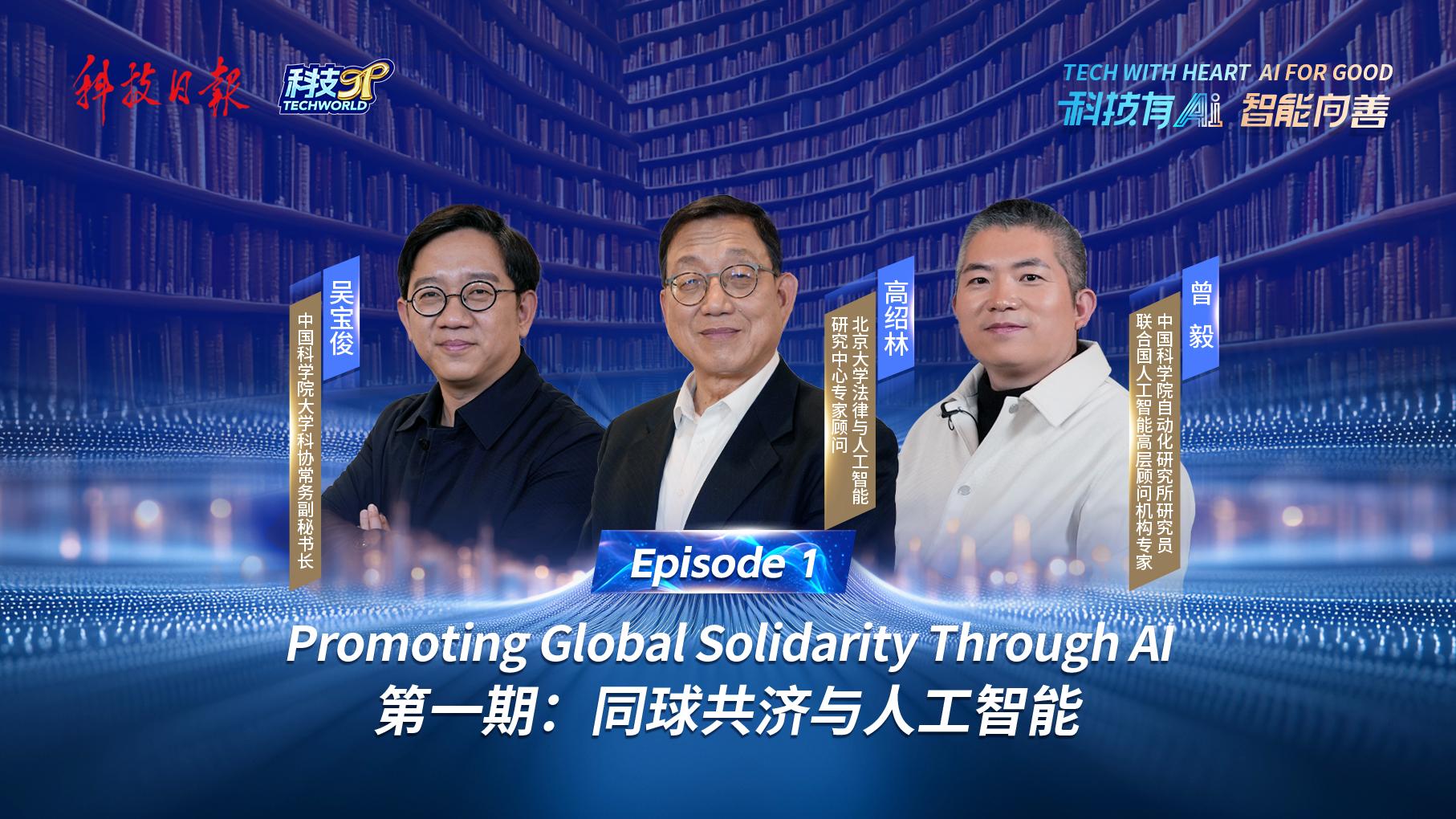
Recently, Science and Technology Daily hosted a panel discussion, "Tech with Heart, AI for Good", on how AI empowers life and bridges human limitations but also needs guard rails to ensure it remains under control.
Omnipresent AI
AI is reshaping the way we live, work and interact with the world. For Zeng Yi, a professor at the Institute of Automation, Chinese Academy of Sciences and an expert of the United Nations' high-level advisory body on AI, the motivation to advance AI technology lies in its potential to liberate humans from repetitive and labor-intensive tasks.
"Combining AI with robotics allows us to redirect human energy toward more creative and meaningful pursuits," Zeng said. He highlighted how AI-powered robots are stepping into hazardous fields such as firefighting, disaster relief and space exploration. Lunar rovers equipped with advanced AI capabilities are conducting complex analyses on the moon's surface — tasks too risky for human scientists.
Besides industrial applications, AI is making a significant impact on environmental conservation such as tracking wildlife.
AI's potential extends into our everyday lives as well. Gao Shaolin, an expert at Peking University Law and Artificial Intelligence Research Center, mentioned a recent road trip during which he drove 3,000 kilometers on highways without coming across a single traffic accident.
"This is extraordinary," Gao said, attributing the improvement to advancements in AI-driven safety features in modern vehicles.
From fatigue-monitoring systems in trucks to self-driving technologies in electric cars, these innovations are drastically reducing the likelihood of accidents.
However, both Zeng and Gao agreed that AI should not aim to replace humans but rather enhance human expertise and efficiency. AI can amplify human capacity, leaving room for creativity and innovation.
Responsible AI
As AI continues to evolve, responsibility becomes a critical issue. Zeng quoted Berkeley, who wrote, "It is often easier for scientists to create a device than to guide it well afterward." Berkeley urged innovators to think beyond breakthroughs and address potential risks.
The question of accountability becomes central. Who will be responsible for any problem caused by AI? "AI is not an independent legal entity," Gao emphasized, pointing out that current AI systems are tools rather than autonomous entities. The responsibility for their actions lies squarely with their developers, service providers and users.
"AI should be as intelligent as necessary, but it must remain under human control," Gao stressed. As Zeng put it, "The key is ensuring AI coexists harmoniously with humans, not as a competitor but as a collaborator."
Wu Baojun, executive deputy secretary-general of the Association for Science and Technology of the University of Chinese Academy of Sciences, said the rapid advancement of AI must be accompanied by efforts to ensure its reliability and safety within ethical frameworks.
"Our research in AI," Wu said, "aims to explore unknown territories, eliminate human fears and make AI more reliable."
Reliable AI
China has consistently demonstrated a forward-thinking approach to AI development, balancing technological innovation with social and ethical considerations.
As Matt Sheehan from the Carnegie Endowment for International Peace wrote in an article, "China is in the midst of rolling out some of the world's earliest and most detailed regulations governing artificial intelligence."
In 2017, China released the Next Generation Artificial Intelligence Development Plan to encourage diverse AI methodologies, such as deep learning, knowledge-based reasoning and large-scale modeling. The plan also emphasized ethical governance, with over a dozen references to social and legal challenges.
In May 2019, it was followed by the Beijing AI Principles, which set out clear guidelines for AI research and development, advocating respect for privacy, human dignity and human rights.
These visions were strengthened in July 2024 when the 78th UN General Assembly unanimously adopted a resolution proposed by China and co-sponsored by over 140 countries. The resolution emphasized the human-centered development of AI, international cooperation, and promotion of AI to benefit humanity as a whole.
Zeng said China's AI strategy reflects a responsible and inclusive approach: "China's AI development strategy is not limited to promoting domestic economic growth. They aim to empower humanity and promote sustainable development goals."
Shared AI principles
AI governance has become a global priority with nations striving to ensure that technology develops responsibly and inclusively.
"We analyzed global AI ethics guidelines and found that 95 percent of the topics are consistent across countries. Concepts like human-centered development, transparency, fairness, safety and privacy protection are widely endorsed," Zeng said, adding that nations worldwide largely agree on the foundational principles for AI ethics and governance.
In 2023, the Bletchley Declaration on AI safety was signed by 28 countries and the European Union. This marked the first broad agreement on the importance of AI safety as a global issue. In 2024, the UNESCO Recommendation on the Ethics of Artificial Intelligence was adopted unanimously by all member states, which is another example of the global consensus.
China is playing an active role in promoting international cooperation on AI governance. "AI must empower all nations, not just the technologically advanced ones. We should guide AI for good with collective efforts and shared responsibilities," Gao said.
Executive Producers: Wang Junming, He Yi
Producer: Fang Linlin
Reporters: Long Yun, Zhong Jianli, Gong Qian
Subtitle Proofreaders:Wang Jing, Cen Yingjie
Video Editing Instructor:Wang Xiaolong
AI Technology Advisor:Liu Yang
Cameramen: Liu Xiao, Li Huitao, Li Tianji
Video Editor: Zhang Shunping
Reviewer: Fang Linlin
Credits:
The Association for Science and Technology of the University of Chinese Academy of Sciences
pkulaw.com
China.org.cn
CHINA FOCUS
Sichuan International Communication Center
Western China International Communication Organization
GD TODAY
PR Newswire