Floating FPSO in South China Sea a First
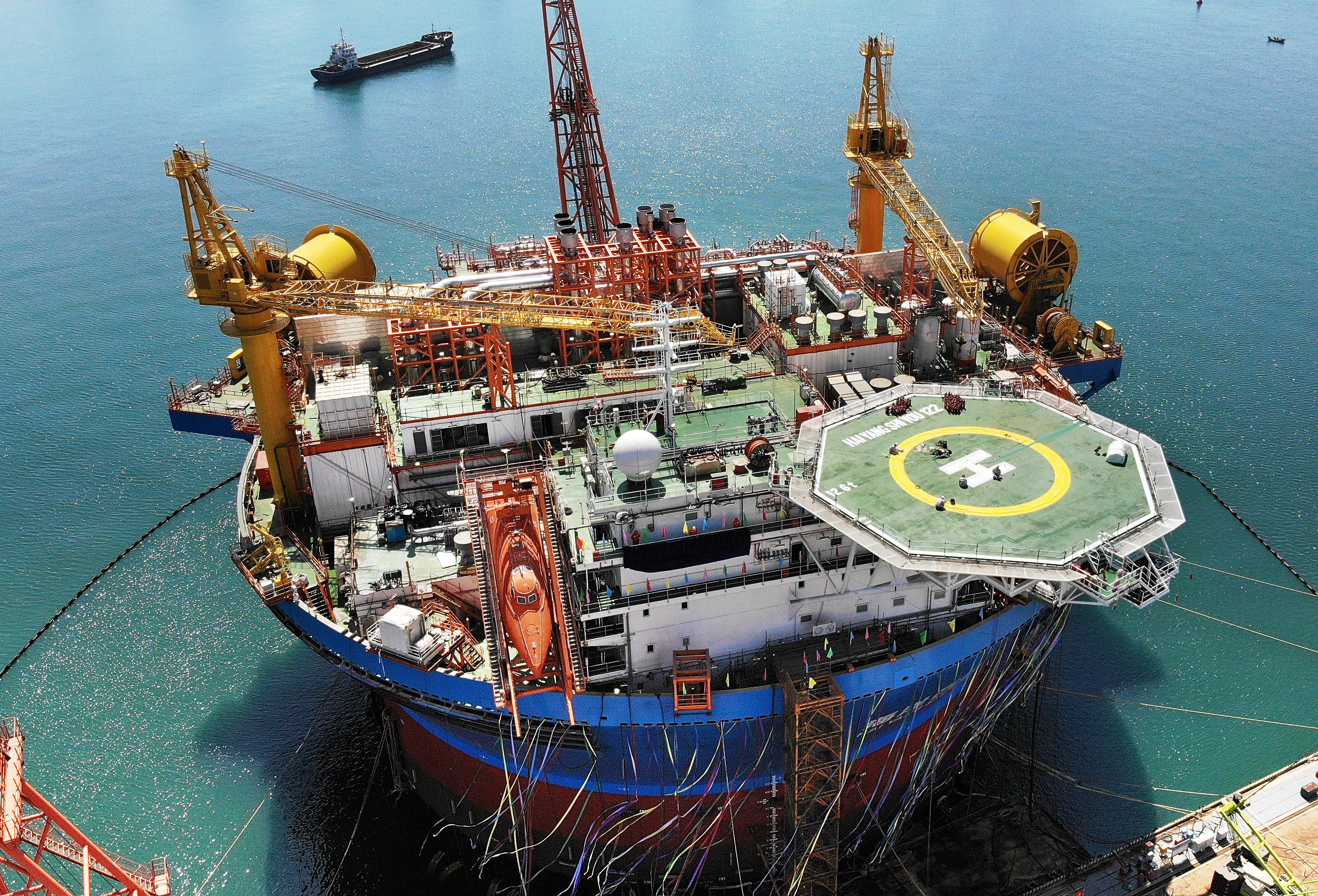
China has launched its first floating production storage and offloading (FPSO) unit. Named the Haikui No.1, it is a self-developed cylindrical FPSO facility, as well as the first cylindrical FPSO put into use in Asia. An FPSO is a floating vessel used by the offshore oil and gas industry to produce and process hydrocarbons and store oil.
Powering high quality development
Officially put into production on September 19, Haikui No.1 weighs a total of 37000 tonnes, towers at a height of about 30 floors, and is 72 meters in diameter. With such a huge area and weight, it looks like a gigantic rice bowl. It has a maximum oil storage capacity of 60,000 tonnes and can also process about 5,600 tonnes of crude oil each day, enough to power 900,000 cars simultaneously.
Haikui No. 1, in collaboration with the deepwater jacket structure Haiji No. 2, has made the re-use of a deepwater oil field in China a reality, extending the production life of the Liuhua Oilfield (China's first self-operated oilfield group, located in the Pearl River Estuary Basin of the South China Sea) by nearly 30 years. On the other hand, it also signals that China has fully mastered the integrated development technology of deep-sea oil and gas engineering over 300 meters, creating a new mode of economic and efficient deepwater oil fields.
"The independent design and construction of Haikui No. 1 not only revitalized the old oilfield that has been in production for decades but also led to the high-quality development of China's offshore oil and gas development engineering equipment industry chain," said Li Da, chief engineer of Engineering Research and Design Institute, China National Offshore Oil Corporation.
Tough and cost-effective contour design
At the beginning of the design stage, the engineers decided that the FPSO should have a large throughput, be cost-effective, and be tough enough to "take root" in the deep waters of the South China Sea, where typhoons are frequent. Through intense brainstorming, a cylindrical FPSO emerged as the best choice.
After settling on the contour of the FPSO, determining the size of the "bowl" was the next challenge.
The R&D team initially planned multiple-scale schemes for periodic motion simulation evaluation. They tried to avoid the main wave frequency and get better hull movement but repeatedly failed. The steep waves in the South China Sea always have a violent pounding effect on the "bowl".
Then, the engineers tried to add a stable "bottom of the bowl" by increasing damping, taking full advantage of the overwhelming resistance of damping on wave excitation. They put a 2.4 metre high damping plate on the "bottom of the bowl" for added stability. Engineers also added zigzag bumps to the damping plate to further release wave energy and improve the damping plate's ability to inhibit heave motion.
Positioning steadily as an anchor
Once the main scale and style had been confirmed, the challenge of securing the cylindrical FPSO had to be overcome. Haikui No.1 can carry more than twice the load of a conventional FPSO in the South China Sea, and its displacement of 100,000 tons is comparable to that of a large aircraft carrier. It is not easy to make it remain perfectly stable in the face of a once-in-a-century super typhoon.
The usual way to solve the positioning problem is to attach a "skirt" to the FPSO. According to this method, the conventional ship type FPSO only needs nine mooring cables, but this "super rice bowl" needs 21, which leads to a significant increase in project costs.
After many demonstrations by the R&D team, under the premise of ensuring stability and security, Haikui No. 1 was firmly anchored with 12 high-strength mooring cables more than 2,500 meters long, so that it could remain steady in the typhoon-ravaged South China Sea. With this method, it is capable to run continuous sea operations for 15 years without the need for docking.