Sci-tech Drives Eco-conservation on Roof of the World
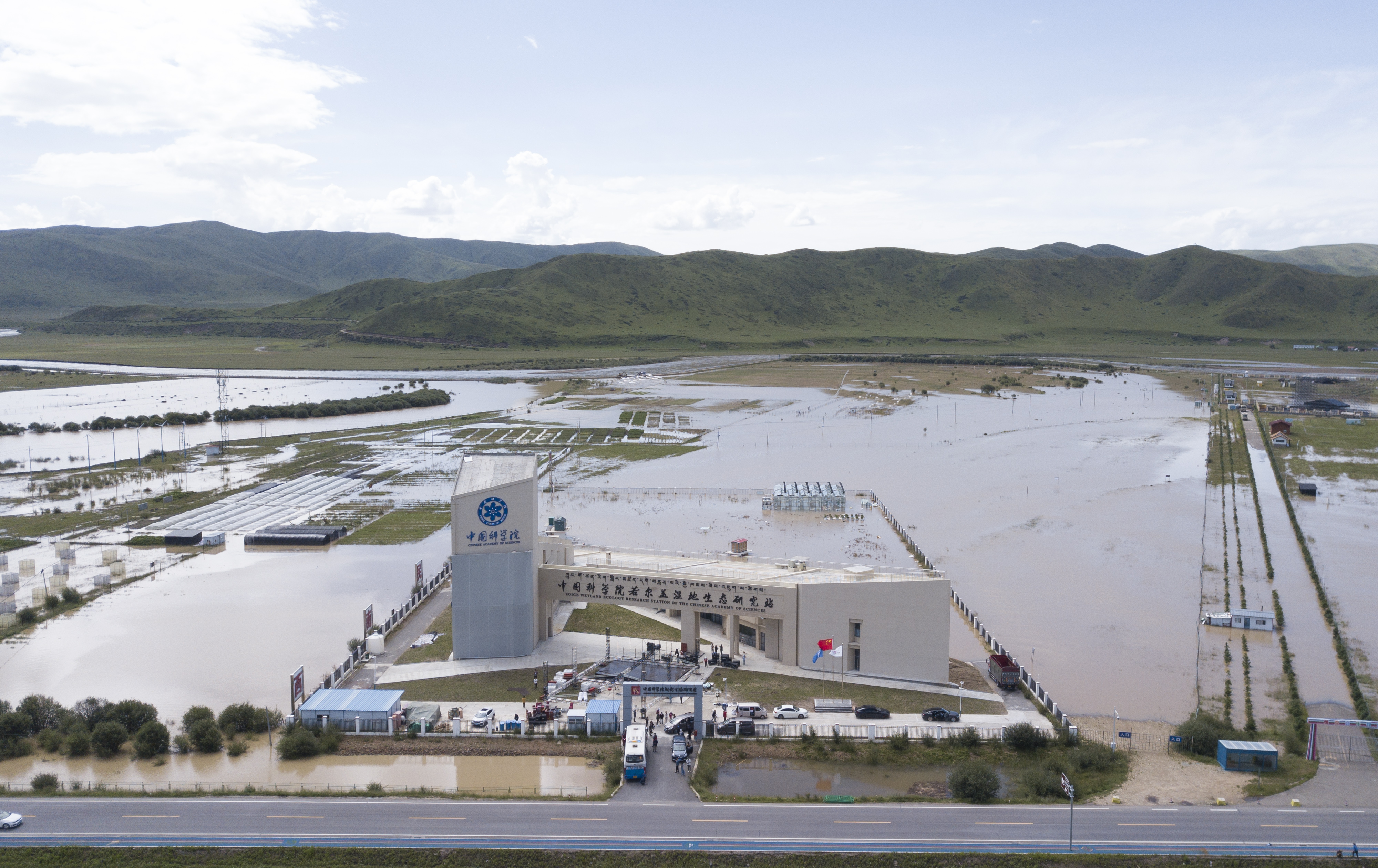
The Zoige Wetland Ecology Research Station of the Chinese Academy of Sciences, located in the Aba Tibetan and Qiang autonomous prefecture in southwest China's Sichuan province, went operational in July. (PHOTO: XINHUA)
In August, China's second scientific expedition and research project on the Qinghai-Xizang Plateau produced a series of major landmark achievements in ecological environmental protection on the plateau, according to the expedition team.
Some of the highlights are carbon sink function analysis, systematic management of mountains, forests, fields, lakes, grasses, sand and ice, and optimizing the construction of national ecological security barrier system, fully demonstrating the important role of sci-tech in ecosystem conservation there.
The process has taken place over a number of years, as Chinese researchers took action to improve the ecological and environmental quality in the Zoige wetland, northeast of the Qinghai-Xizang Plateau. Serving as an important ecological security barrier, the largest alpine peatland in the world plays a key role in carbon storage and climate mitigation. However, the region is facing biodiversity loss and a weakened wetland ecosystem against the backdrop of global climate change.
To promote wetland conservation, the Zoige Wetland Ecology Research Station of the Chinese Academy of Sciences (CAS) was called in, in July. The station is also expected to provide sci-tech support and policy recommendations for regional ecological protection and sustainable socio-economic development in southwest China.
The station has established environmental monitoring and data-sharing platforms, global climate change research platforms, as well as wetland grassland degradation and restoration research platforms. It also features observation facilities that improve the accuracy of data monitoring, helping researchers study how the carbon sink capacity of alpine meadow ecosystems responds to global climate changes.
The Shannan wide valley section of the Yarlung Zangbo River was once an area severely affected by sand hazards. Since the 1980s, locals have planted over 45 million trees, building a "Great Green Wall" that stretches over 160 kilometers in length and 1.8 kilometers in width.
In recent years, researchers from the Institute of Mountain Hazards and Environment (Chengdu) of CAS have optimized these protective forests. By comprehensively investigating the sandy land conditions in the middle and upper reaches and considering factors such as climate, topography, soil, vegetation and the degree of sandiness, they have implemented an ecological management model based on a "burying-paving-blocking-storing" approach.
This approach requires researchers to bury organic matter to improve soil fertility, cultivate plants with high wintering survival rates to block wind erosion and sand loss, and create "micro-reservoirs" to replenish water for plants during dry periods by adding an eco-friendly water retention material to the soil, according to Zhou Ping, a researcher at the institute.
The high-altitude ecosystem station promotes ecological security barrier construction
situated at over 4,700 meters above sea level. The Xainza Alpine Steppe and Wetland Ecosystem Observation Station in Nagqu city, Xizang autonomous region, is the highest comprehensive ecological monitoring station in the world. The station features three specialized laboratories for biology, soil and moisture, as well as an integrated observation site, focusing on key issues related to the protection and construction of the national ecological security barrier.
The station's unique geographic location provides an extensive range for monitoring, allowing researchers to monitor and assess the impact of human activities on the natural environment and ecosystems, and predict how changes in the plateau's environment and ecosystem functions will affect ecological security in our country and even across Asia, said Wang Xiaodan, head of the station, who has worked on the plateau for more than 20 years.
To uncover the scientific laws of plateau ecology, he has consistently conducted expeditions into the wilderness on foot. Wang has left his footprints on over 60 counties in Xizang. His longest research expedition lasted for 3 months, covering 3,000 kilometers.
Wang is not alone. Generations of Chinese researchers have rooted themselves on the Qinghai-Xizang Plateau to conduct scientific explorations and promote ecosystem conservation of the snowy land.