Leading Global Science with Breakthroughs
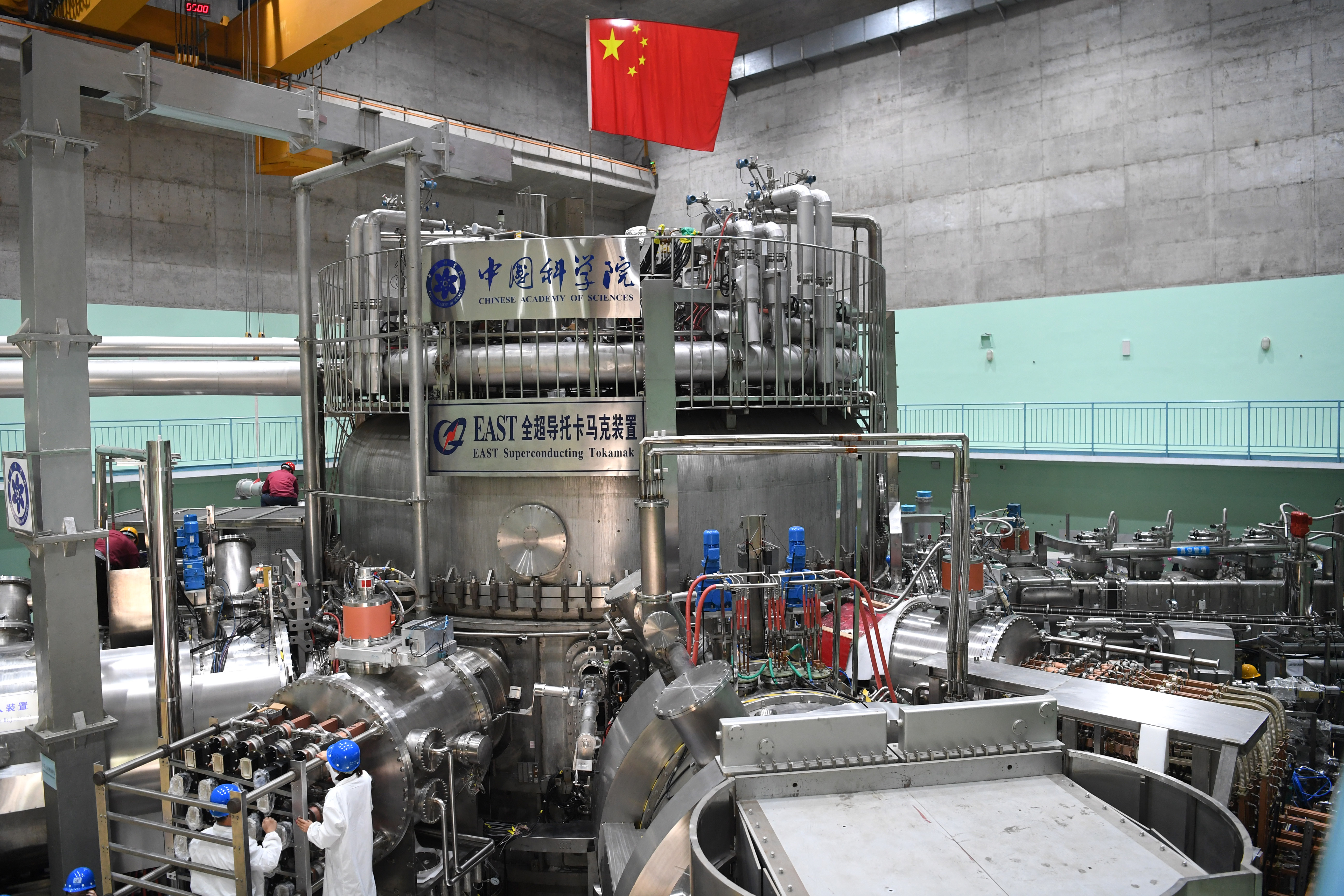
The?experimental advanced superconducting tokamak (EAST), or the Chinese "artificial sun."?(PHOTO:?Xinhua)
Edited by GONG Qian
Since the National Conference on Science and Technology Innovation in 2016, China has attained a number of significant scientific and technological achievements, playing a leading role in the global sci-tech community.
At the forefront of critical research
Over the past eight years, Chinese scientists?have tackled cutting-edge scientific issues and completed a series?of crucial basic research tasks, consolidating basic research.
In fundamental physics, China has achieved international leadership in areas such as quantum communication, superconductivity and topology in?physics, and magnetic confinement long-pulse plasma.
In 2016, China launched the world's first quantum satellite “Micius”,?named after an ancient Chinese philosopher. “It’s a huge achievement for quantum entanglement and quantum science,”?physicist Thomas Jennewein of the University of Waterloo in Canada told Science News. “China is now clearly taking the world leadership in this area of quantum communication.”
Several years later, Chinese scientists set up the world's first integrated quantum communication network that combines 700 optical fibers on the ground with two ground-to-satellite links and realized quantum key distribution between more than 150 users over a combined distance of 4,600 km.
In November 2017, China successfully created?from somatic cells?the world’s first cloned?macaques, named Zhong Zhong and Hua Hua. With this success it became a pioneer in disease and brain science research, using cloned macaques as animal models.
China has?also?achieved significant?and historic?breakthroughs in deep space exploration.?For example,?the ascender of China's Chang'e-6 probe lifted off from the lunar surface on June 4, carrying samples from the moon's far side, an unprecedented feat in lunar exploration history. Other major?achievements include?Zhurong,?the?first?Mars?rover?landing?on?the?red?planet, and?completion?of?the?Tiangong?space?station.?Those?feats?have?greatly?contributed?to?the?exploration?of?the?mysteries?of?the?universe.
Mega projects for advanced research
China has achieved remarkable progress in both the quantity and quality of mega science projects, promoting?basic research and innovation.
In November 2020,?China's manned submersible Fendouzhe, which means “Striver”,?completed its 10,000-meter sea trial. During the expedition,?the submersible set a new national record by diving to a depth of 10,909 meters in the Mariana Trench. This marked China's entry into the top echelon of deep-sea scientific research.?The domestically developed Fendouzhe?has greatly improved the independent innovation level of China’s deep-sea equipment technology.
In August 2022, a hybrid magnet built by scientists of the Steady High Magnetic Field Facility in Hefei, east China, produced a steady field of 45.22 tesla, the highest steady magnetic field by a working magnet in the world. This broke the previous record of 45 tesla by U.S. researchers in 1999.
This achievement is a milestone in magnetic technology. Stronger magnetic fields help scientists see the internal structure of materials more clearly, leading to a better understanding of the world and the development of new technologies.
The experimental advanced superconducting tokamak (EAST), or the Chinese "artificial sun," achieved a steady-state high confinement plasma operation for 403 seconds on April 12, 2023. In the same year,?Chinese scientists unveiled a quantum computer prototype, known as “Jiuzhang 3.0”, with 255 detected photons. It could solve Gaussian boson sampling problems 10 quadrillion times faster than?the world's fastest supercomputers at that time.
As of April 2024, China’s Five-hundred-meter Aperture Spherical Radio Telescope (FAST) had identified more than 900 new pulsars?since its launch in 2016. Using?the world's largest single-dish radio telescope, Chinese scientists?have found evidence of the existence of nanohertz gravitational waves. The discovery is pivotal in understanding the structure of the universe and the behavior of supermassive black holes, paving the way for future exploration of gravitational waves.
With its commitment to innovation and research, China is poised to unlock new frontiers in various fields and?take its sci-tech strength to a higher level to support national development?and benefit the world.?