Chinese Scientists Make Breakthrough in fNIRS Imaging Technology
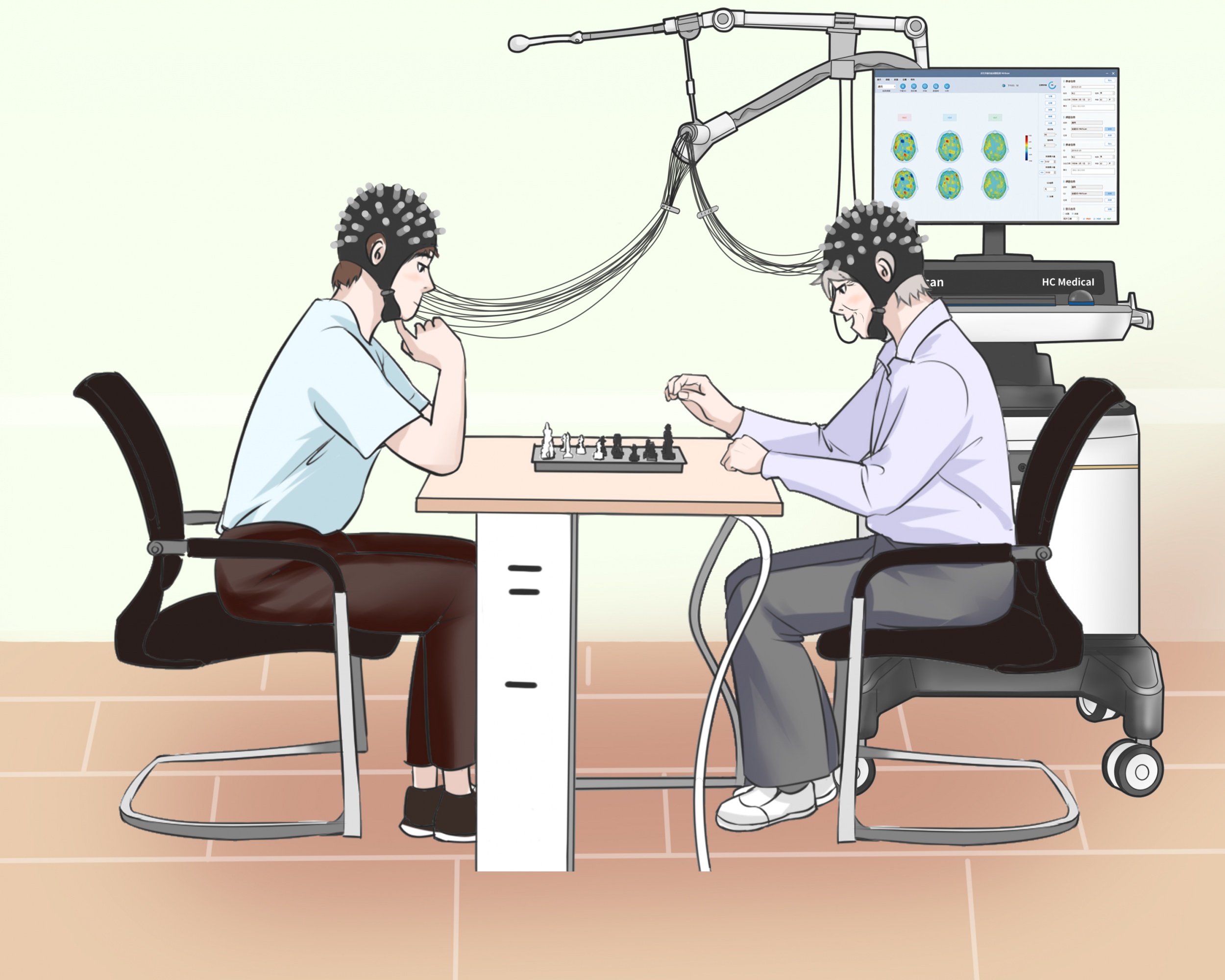
Photo?shows?the?application?of?fNIRS brain imaging equipment.?(Photo?from?official?website?of?Huichuang)
By Staff Reporters
For a long time, the evaluation and diagnosis of mental and psychosomatic diseases have been lacking objective biological indicators. Now, the application of functional near-infrared spectroscopy (fNIRS) imaging technology may help solve this problem.
A research team from Beihang University (BUAA) has developed fNIRS brain imaging equipment with over 100-channels. Based on fNIRS imaging technology, an intelligent disease diagnosis and treatment model has also been established.
Fit for purpose
High resolution imaging of brain activity in its natural state had been a challenge worldwide untill the advent of fNIRS imaging equipment, which is now considered to be a solution to this problem. The device can record brain activity as people walk, drive, talk, play a musical instrument or games, and also be used on restless children, claustrophobic patients and people who are unable to undergo MRI scans.
However, the current fNIRS equipment, with a unit price of millions of RMB, cannot effectively image the areas covered by people’s dark hair, such as the parietal lobe and occipital lobe. This is because many Westerners have light colored hair, while Asians have dark hair, and dark colors absorb 1,000 times more infrared light, said Wang Daifa, who leads the research team at BUAA.
After hundreds of experiments, setbacks and verifications, Wang’s team finally made a breakthrough in the physical limit of near-infrared ultra-light detection technology and original signal extraction technology, to overcome the challenge imposed by dark hair with their whole brain imaging technology.
Higher resolution
In 2016, Wang’s team founded Danyang Huichuang Medical Equipment Co. Ltd (Huichuang) to manufacture new equipment of high resolution imaging." After three years of efforts, we began using fNIRS imaging equipment in the clinic, initiating the development of homegrown high-end equipment in this field,” said Fu Qijun, R&D director of Huichuang.
The R&D team did not stop there. Their next goal was to improve the accuracy of fNIRS imaging. Fu said that the advantages of fNIRS imaging technology are many, but the disadvantages are also obvious. “It is accurate to only about 3 cm, while the accuracy of functional MRI (fMRI) is 3 mm,” Fu said.
Scientists have long been trying to improve the accuracy of fNIRS imaging to the level of fMRI, and in recent years, the development of artificial intelligence and deep learning have assisted to solve this problem.
After numerous attempts, Wang’s team found a way, which combines neural network-based image reconstruction frameworks and models with traditional physical models, to improve the spatial resolution of fNIRS imaging to about 5 mm.
Intelligent interpreting system
As fNIRS imaging is a new technology and outputs new type of images, several questions emerged that need answers. How to interpret the image? What are indicators of insomnia, depression or autism? What about medication?
"We want to build a model that can help doctors analyze the image information and support disease diagnosis, classification and evaluation of therapeutic effect throughout the clinical process," said Deng Hao, software development director of Huichuang.
The team has established cooperation with dozens of clinical institutions, and has collected tens of thousands of dynamic brain function data. The software developers designed a model to collect disease-related data and establish the link between data and disease to support diagnosis.
To date, fNIRS imaging technology and related models have been demonstrated in more than 800 institutions including Peking Union Medical College Hospital, Shanghai Huashan Hospital and Tsinghua University. For Wang and his team, after nearly 20 years of effort, they are on the threshold of taking a giant leap for science and humankind.