Blueprint to Fast Track a 'Beautiful China'
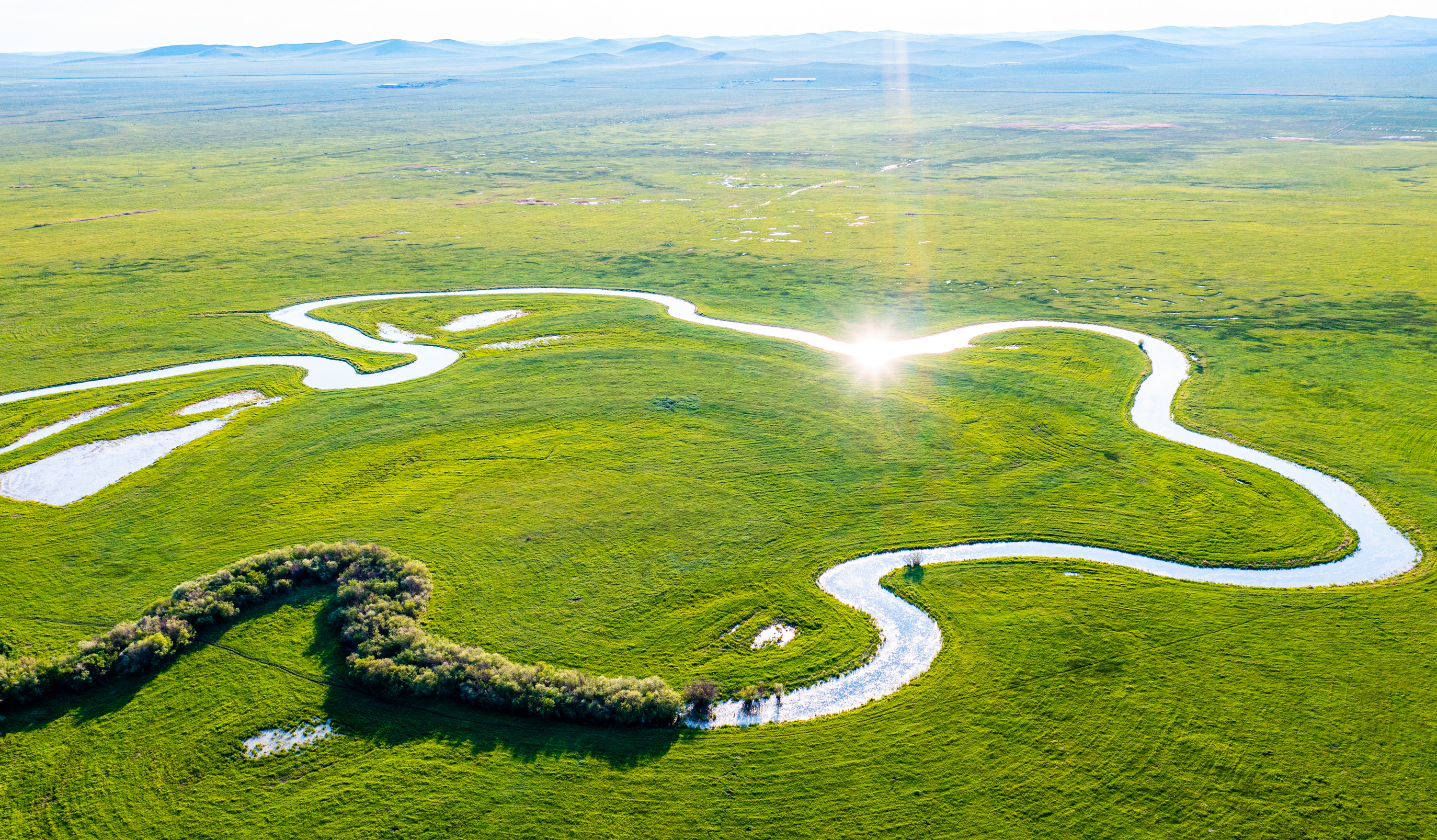
The Wulagai grassland in Xilin Gol League, Inner Mongolia autonomous region in northeast China. (PHOTO: XINHUA)
By ZHONG Jianli
The goal of building a "Beautiful China" will be basically achieved by 2035, when green ways of production and life will be broadly adopted and the country's ecological environment will improve fundamentally.
This is the tenor of a guideline recently issued by the Communist Party of China (CPC) Central Committee and the State Council to comprehensively promote the development of a "Beautiful China."
The document says that by 2027, China will see a continuous decrease in the total discharge of major pollutants and improvement in its ecological environment. A "Beautiful China" in all respects will be built by the middle of the century.
The concept of building a "Beautiful China" was first put forward at the 18th National Congress of the CPC in 2012. Since then, the local governments of provinces including Sichuan, Shandong and Hainan have begun work on building a beautiful land with blue sky, green land and clear water.
As some structural and long-term pressures on ecological and environmental protection have yet to be resolved, the guideline stresses the need for maintaining determination to enhance ecological civilization while pursuing a path of balanced and sustainable development.
It provides an extensive roadmap and specific policy measures to comprehensively advance building a "Beautiful China" and expedite modernization that harmonizes humans with nature.
Key to the proposed plan is accelerating the transition to environment-friendly development practices. The guideline advocates deep integration of digitalization, and intelligent and low-carbon strategies within industries, noting that by 2027, the proportion of new energy vehicles among all new automobiles should reach 45 percent.
The document outlines a comprehensive plan to implement a step-by-step carbon peaking action. By 2035, non-fossil energy is expected to constitute an increased proportion of total energy consumption, and the creation of a more effective, dynamic and globally influential carbon trading market is on the agenda.
In the sustained and intensive efforts to combat pollution, by 2027, the national average concentration of fine particulate matter should decrease to below 28 micrograms per cubic meter, and the target for 2035 is below 25 micrograms per cubic meter.

Two milu deer wander in the Shishou Milu National Nature Reserve in central China's Hubei province. (PHOTO: XINHUA)
The document also proposes establishing demonstration areas for building a "Beautiful China," such as the Xiong'an New Area, Yangtze River Economic Belt and Guangdong-Hong Kong-Macao Greater Bay Area.
To achieve the goals, it stresses the need for strengthened sci-tech support, calling for the development of green and low-carbon technologies. It proposes to build a market-oriented green technology innovation system. In addition, key national basic research plans should include R&D on pollution reduction, multi-pollutant collaborative emission reduction, climate change adaptation, biodiversity conservation, new pollutant treatment and nuclear safety.
At the same time, the guideline emphasizes expediting digital empowerment for building a "Beautiful China." This involves deepening the application of digital technologies, constructing a digital governance system, and establishing a modern eco-environment monitoring system and a smart law enforcement system.
Significantly, the policy calls for joint efforts in building a global ecological civilization.
It proposes to adhere to the principle of common but differentiated responsibilities and promote a global environmental and climate governance system featuring fairness, rationality and win-win cooperation, while underscoring the need to deepen international cooperation on climate change, biodiversity protection, marine pollution control and nuclear safety.