U.S. Should Change Its Distorted Perception of China
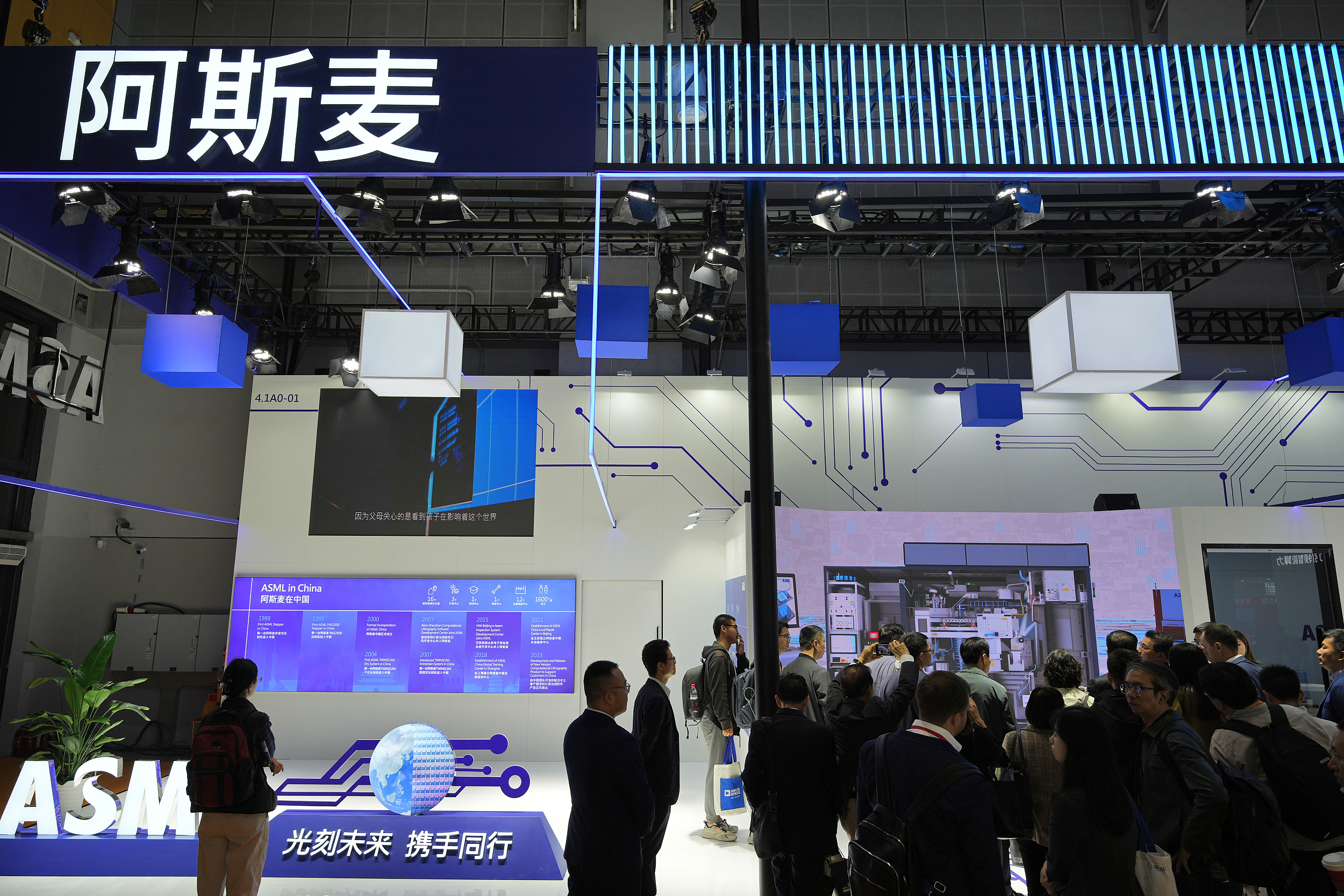
Visitors?at the booth of Dutch microchip machine manufacturer ASML at the 6th China International Import Expo on November 8, 2023. (PHOTO: VCG)
By?GONG Ting
On January 1, Dutch microchip machine manufacturer ASML said its government, at the request of the U.S., had revoked an export license covering the shipment of some of its equipment to China. This is a clear indication that the U.S. is making the process of global supply chains more ideological.
In recent years, containment in the high-tech field has been at the core of the U.S. strategic competition strategy towards China. In Washington's view, cutting off and restricting China's access to frontier technologies is key to preventing the rise of China's technological and comprehensive national strength.
From decoupling to de-risking, although the U.S. has realized that it is impossible to cut off economic ties with China in a globalized world, it is maintaining and even intensifying a high-tech containment policy towards China.
For instance, the U.S. has been continuously tightening its export control policies towards China. More and more Chinese high-tech enterprises were moved onto a series of export control lists—the entity list, prohibiting them from purchasing many high-tech products, components and services.
The U.S. is also identifying an increasing number of frontier technologies to bring them under the scope of strict restriction, such as semiconductors, artificial intelligence, and quantum tech. All points to its newly published policies in semiconductor export control towards China being extremely hawkish.
However, major U.S. semiconductor giants have expressed their dissatisfaction and opposition to such policies, since China is the world's largest semiconductor market and an extremely important sales market for these companies.
Additionally, the U.S. is also attempting to establish high-tech supply chains aiming at excluding China, especially in areas such as semiconductors, critical minerals, and electric vehicles. It is trying to change the logic of global division of labor in such industries based upon production efficiency, and is working towards so-called friend-shoring among its allies.
Apart from this, a good number of measures hindering bilateral sci-tech exchanges and cooperation used in the Trump administration are being continued in the Biden administration. Such measures have brought about apparent harm to bilateral scientific cooperation projects and personnel exchanges. This is shown by the China Initiative of the U.S. Department of Justice and Federal Investment Bureau, creating a strong sense of fear among scientists, visiting scholars, and international students on both sides of the divide.
Recently, it seems that the U.S. made some adjustments in its policy overtones. Beforehand, the U.S. sent negative signals in regard to renewing the China-U.S. Science and Technology Agreement, which was a milestone in sci-tech cooperation between the two countries. In August 2023, the White House announced a six-month extension of the agreement, in order to negotiate renewal issues with China. Last month, U.S. Ambassador to China Nicholas Burns said he had started talks with Beijing on renewing the cooperation agreement.
In addition, China and the U.S. have also reached a consensus on establishing an intergovernmental dialogue on artificial intelligence in November 2023. These moves may alleviate the tension in the high-tech field between the two sides in the short term.
However, it should be noted that as long as the U.S. government does not change its distorted perception of China, and does not change its strategy centered on competition with China, it will be difficult for the U.S. to make substantial adjustments to its containment policy in high-tech fields against China.
The International Science and Technology Cooperation Initiative put forward by China points out the direction for jointly building a global science and technology community. As human society is facing more and more global challenges, it needs science, technology and innovation cooperation to explore solutions to global issues, rather than artificial obstacle to undermine the common interests of the international community.
GONG Ting is an associate research fellow at the Department for American Studies, China Institute of International Studies.