Nature Editorial: Belt and Road Initiative is boosting science — the West must engage, not withdraw
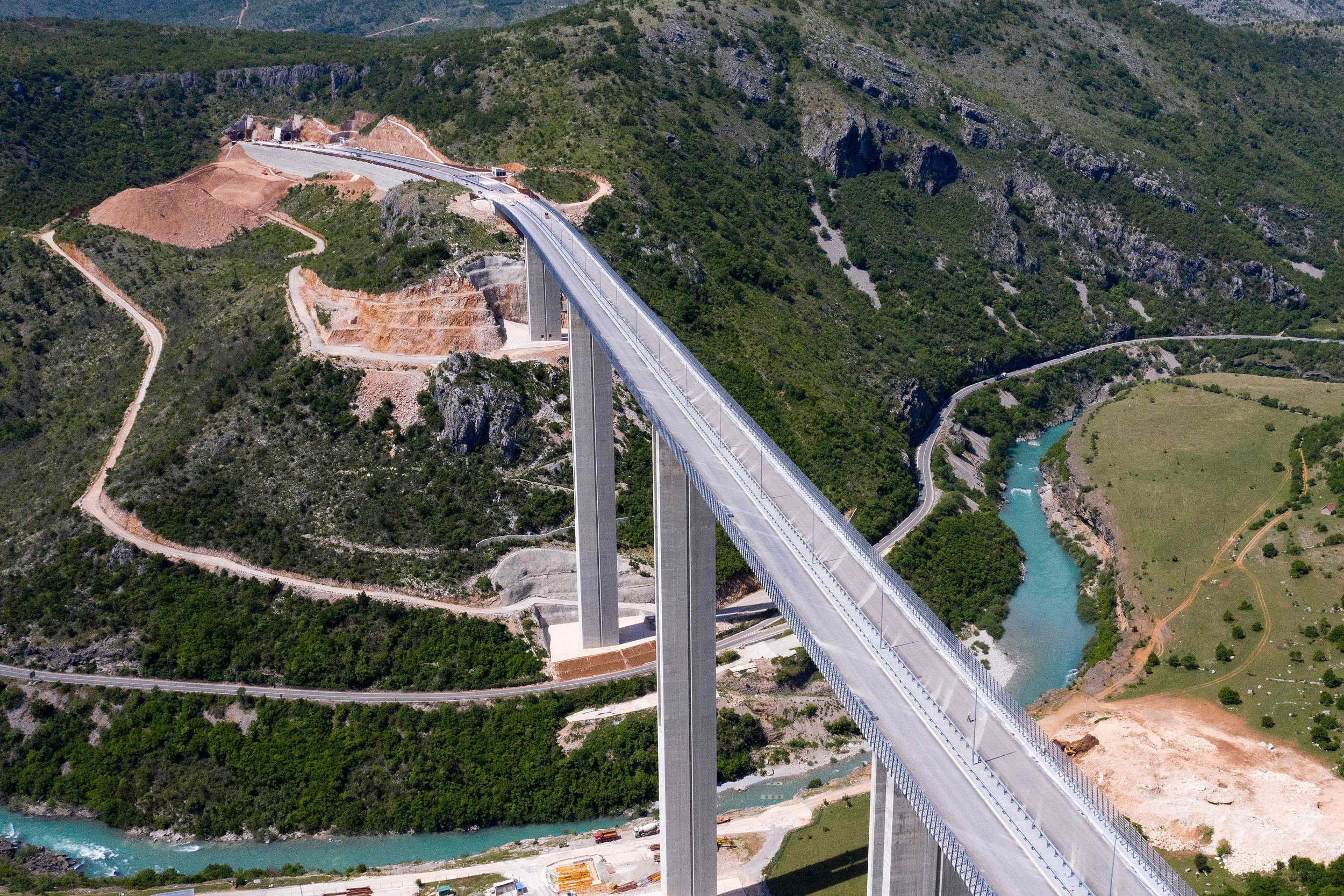
An aerial views shows a part of the new highway connecting the city of Bar on Montenegro’s Adriatic coast to landlocked neighbour Serbia, (Bar-Boljare highway) on May 11, 2021, which is being constructed by China Road and Bridge Corporation.?(PHOTO:?VCG)
In 2018 and 2019, Nature sent teams of reporters to countries involved in the BRI to explore the project’s science aspects. We spoke to more than 100 people, including researchers and policymakers, to get a measure of China’s ambition to expand its international research collaboration. These collaborations were being forged in addition to, not instead of, China’s research links with Europe and the United States.
In science, the BRI is coming into its own. In 2019, Nature travelled to a large construction site where a new university was being built. The Pak-Austria Fachhochschule, a collaboration between Austria, China and Pakistan, opened in 2020. Its first students will graduate next year, and it has already opened collaborative research centres in artificial intelligence, critical minerals and railway engineering. In Beijing, Nature talked to some of the 200 international doctoral students selected annually and funded by the Chinese Academy of Sciences (CAS) and the UNESCO World Academy of Sciences, based in Trieste, Italy. The scheme now supports 300 new PhD scholars a year.
Last month, in a collaboration between CAS, the National Museums of Kenya and the Sino–Africa Joint Research Center near Nairobi, researchers published the first in a 31-volume study called Flora of Kenya, which will catalogue nearly 7,000 plant species. And this month saw the announcement that the space agencies of Pakistan and Azerbaijan will join other international partners in China’s lunar research-station project, which aims to build a permanent base on the Moon in the 2030s.
The Alliance of International Science Organizations is a network of science institutions that advises on science policy for the BRI. Based at CAS, it has global representation. It organizes PhD scholarships in China, as well as funding calls for projects between its 67 institutional members, spread across 48 countries — up from 37 members in 2019. The UN’s science and education agency UNESCO is involved, as are a small number of European science academies. More academies from Western Europe should consider joining. US academies should also look at participating.
Last month, the European Union, the United States, India, Saudi Arabia and the United Arab Emirates announced plans for their own BRI-style infrastructure project connecting Europe, the Middle East and India. This might also include research cooperation. The scheme will provide opportunities for participating countries, and is to be welcomed. But the BRI is not going away and the West should engage with its research programmes.
China wants to share its experiences of how to escape poverty, having made great strides towards that goal in a generation. But to tackle global economic, environmental and political issues, policymaking and governance need to be research-based and multilateral. China and its Western partners must take a more sophisticated approach to how they deal with one another amid rising geopolitical tensions. Stopping person-to-person contact and ending longstanding institutional research relationships is not the way to address climate change, prevent wars, or avoid or tackle another global financial crisis.
Source:Nature
doi: https://doi.org/10.1038/d41586-023-03299-6