Robotic Innovation in Medical Field
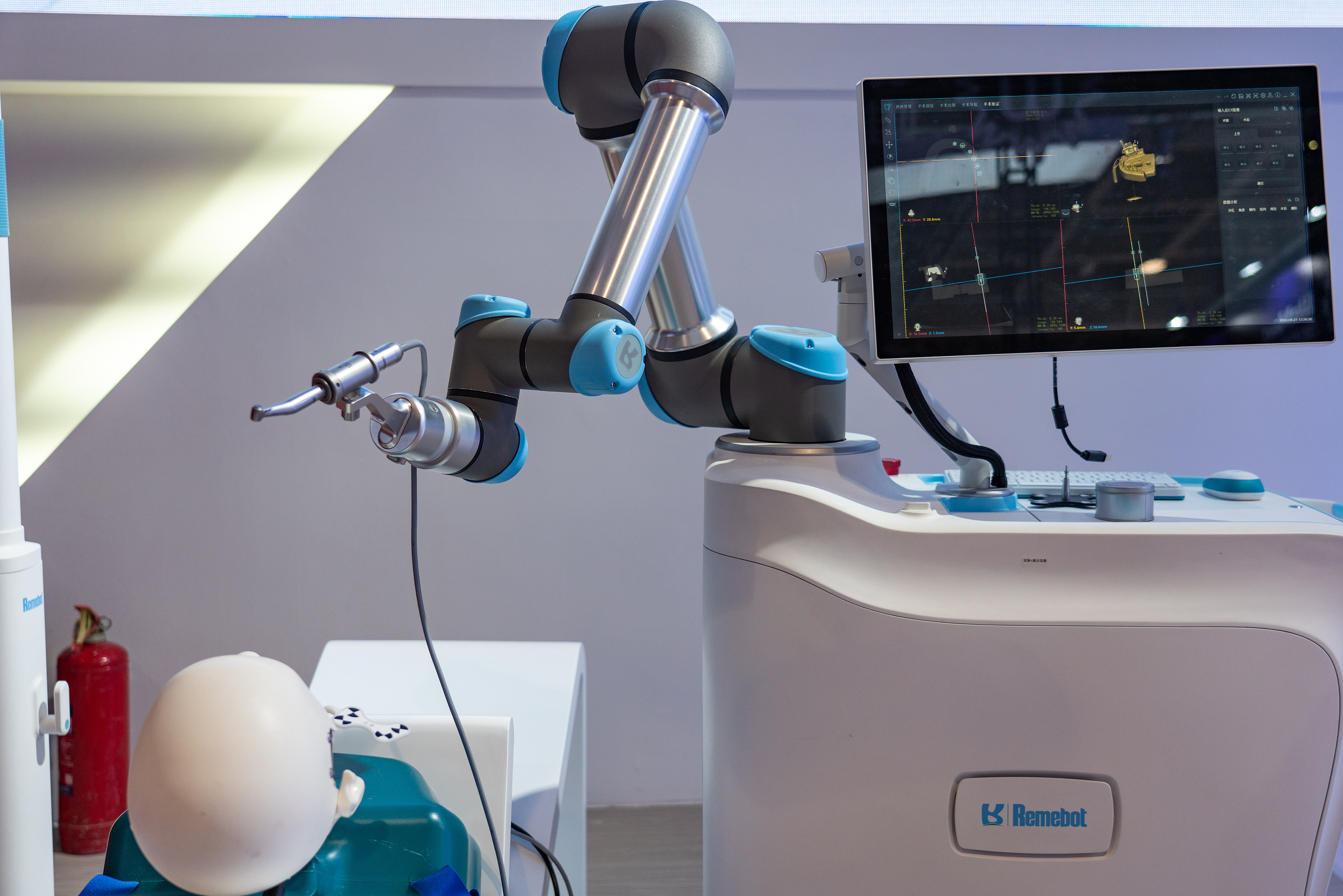
A?bone and joint surgery robot is?demonstrated?at the 2022 World Robotics Congress, Beijing, Aug. 21, 2022.?(PHOTO:VCG)
By?CHI?Wenqiang?&?Misbahul?Ferdous
Surgical robots are a significant technological advancement in healthcare that emerged in the 1980s to assist clinicians. The da Vinci robot is the most successful platform and has been installed more than 300 units in China.
Using robots in the medical field offers several benefits, including improved patient care, cost reduction, and a safer environment for both patients and clinicians.
The da Vinci robot is a telemanipulator for laparoscopic surgery, which enables surgeons to manipulate dexterous instruments intuitively while also improving surgical precision and stability. Similarly, Edge Medical from China released another four-arm robot that can manipulate three instruments simultaneously with one further arm to hold the endoscope. These robots can be gigantic in size, making it difficult to fit them in an operating room. Beijing Shuri Medical has proposed a single-arm system that can achieve similar surgical outcomes. The arm integrates four snake-shaped instruments together, which are extremely flexible but still offer great strength and stability.
Robots can hugely improve the precision of the surgical procedures while enhancing navigation to deep lesions inside the human body. The robotic navigation system can help the surgeon plan the path for surgical implants inside the bones, especially in orthopedic surgery. The navigation system uses information from pre-operative CT images as well as real-time tracking of the instruments and patients during the operation. Beijing Tinavi Robotics developed a robotic arm that can precisely place the implants following its navigated path, which has already benefited 30,000 procedures in China.
Robots can also reduce health risks to patients and clinicians in hazardous environments, such as reducing exposure to pathogens during the COVID-19 pandemic. Another such example is in radiation reduction in areas where X-ray imaging is heavily relied on. Shanghai Operation Robot is a multi-arm platform used to manipulate elongated instruments such as catheters and wires for vascular intervention. The clinician can sit outside the operating room to perform the procedure while eliminating potential radiation-related health risks. The robotic manipulator can also improve instrument stability since catheters are extremely flexible and unstable to manipulate.
More advanced innovations in medical robotics focus on micro/nanoscale treatment inside the human body. Neuralink starts a new era for Brain-Computer Interface, proposing a "Stitching" robot that can insert micro-sized electrodes into the brain, which can perceive signals from some functional regions.
Not far off from something you would read about in science fiction, people can now swallow a tiny robot for better healthcare. AnX Robotica made a capsule robot named Navicam, whose movements are controlled by clinicians to view the stomach from inside the patient's body. It significantly improves patient comfort while also reducing risks and operational difficulties associated with conventional endoscopic techniques.
Recent developments are geared toward nanobots — tiny machines that operate at the nanoscale level, about a millionth of a millimeter. These robots can be programmed to manipulate cells and other biological materials at the molecular level, making them an exciting new tool for medical research and treatment. One promising application of nanobots is in the field of cell manipulation. By using nanobots, scientists can precisely target and manipulate individual cells, allowing for more accurate and efficient testing of new drugs and therapies. Additionally, nanobots can be used to deliver drugs or other therapeutic agents directly to diseased cells, potentially reducing side effects and increasing effectiveness. The development of nanobots for cell manipulation is still in its early stages, but the potential for this technology to revolutionize medicine is inspiring.
???
These two authors are researchers from Lepu Medical Company.
???